Have you heard the one about the rabbi, the priest and the imam who walk into a guachinche (one of those cosy, no-frills family taverns on Tenerife that serve homemade wine) to ask where the Canary Islands got their name from, and the owner tells each of them a totally different story?
No, I don’t know that joke either. I just made it up – and it would probably be a terribly tiresome one if I insisted on carrying it on – but the story could easily have happened in real life. The truth is, we don’t know for certain where the Canary Islands got their name. We have ideas, of course, and each of them has a source or two to lean on, but if we’re honest, everyone will end up believing whichever one they like best.
So which one will you be backing by the time you reach the end of this article?
First things first: let’s take the bird off the table
The most common mix-up deserves to come first, because you may well have had it in mind when you saw the title. No, the islands were not named after the canary bird. It happened the other way round: the little yellow finch is called a canary because it comes from the islands. Its wild ancestor (Serinus canaria) still lives there today and is far less yellow than its caged cousins, more of a greenish grey. The bird went on to tour the royal courts of Europe, and the name caught on so well that we ended up naming a colour after it too.
So the question isn’t what kind of bird gave the islands their name, but what the islands were named after in the first place, a name the bird later inherited.
Pliny’s dogs
Of all the ancient authors, Pliny the Elder is the one quoted most often. In his Natural History, around AD 77, he set down everything that was known about the expedition of King Juba of Mauretania. Juba was an ally of the Romans, ruled over what is now roughly Morocco and Algeria, and sent ships out into the Atlantic to hop over and have a look at the islands in the west. According to the report, the explorers found traces of buildings on one island, palm groves with dates, plenty of birds, and the stench of enormous sea creatures washed up on the shore. And something else: a great many dogs of gigantic size. Since the Latin word for dog is canis, later visitors referred to the place as Canaria, which means roughly “the land of dogs”. Legend has it that two of these colossal hounds were taken back to the king as a gift.
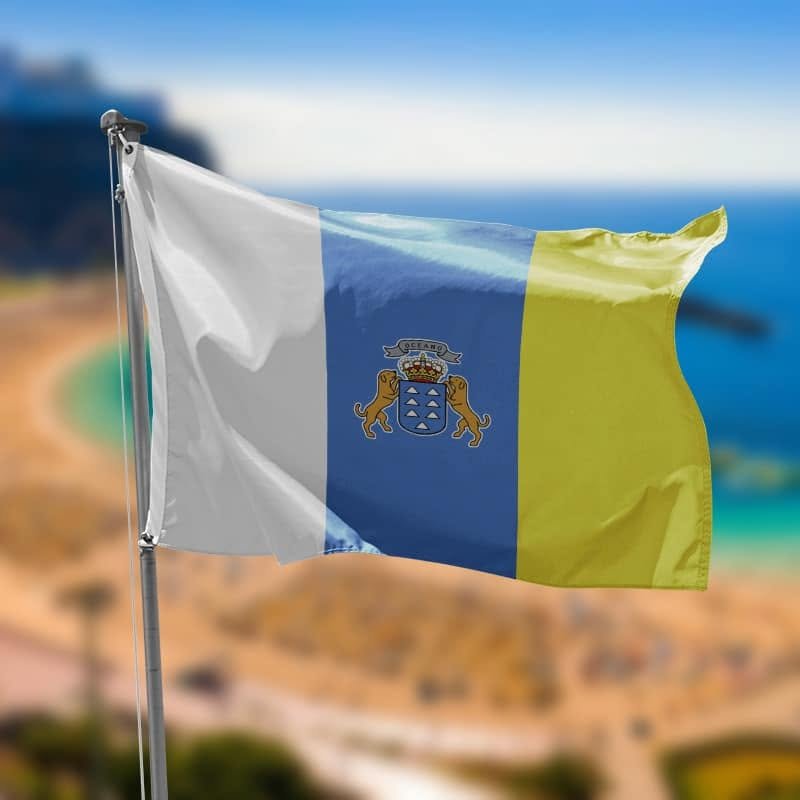
At first only what is now Gran Canaria bore the name; it later spread to the whole archipelago. The dog explanation has remained the most popular ever since, and the coat of arms of the Canary Islands – see the featured image above – still has two dogs standing beside the shield, which shows how deeply the idea has taken root.
There is a catch, though. There is no evidence that dogs overran the islands in antiquity, and it is also awkward that, according to Pliny’s notes, the place was uninhabited, while we know that indigenous people lived there. That doesn’t disprove anything, since an account like this passed through many hands before it was written down, but it may well raise an eyebrow.
And what if the dog was actually a seal?
This is where the Latin canis marinus comes in: the “sea dog”, the word for a seal. Specifically the monk seal (Monachus monachus), which, judging by the remains that have been found, once lived in large colonies along the Canarian coast. Sadly it has disappeared from the islands, though a few still survive on Madeira. If Juba’s men really saw seals on the shore, it would have been easy to call them dogs by mistake. And why? Anyone who has watched a round-headed, whiskered seal bobbing out of the water and making a bark-like sound will find the association not so far-fetched – especially if they had never seen a seal before, or had, but didn’t know that’s what they were looking at. Seen this way, the eyewitness report of a vast multitude of enormous dogs on the shore suddenly sounds a lot less absurd.
Legend also has it that the Isla de Lobos, off Fuerteventura, got its name in a similar way, from the “sea wolves”, which is to say monk seals.
A Berber tribe
The third explanation ties the name to people rather than animals. According to some historians, a Berber tribe called the Canarii lived around the Atlas Mountains, and the name reached the islands either because the Romans or the Phoenicians took some of its people there, or because the islanders themselves were related to them. The latter is not just wishful thinking: research suggests that the indigenous peoples of the islands (the Guanches on Tenerife, the Bimbaches on El Hierro, the Majos on Fuerteventura and Lanzarote) all had North African, Berber roots.
The two theories don’t rule each other out, either. The name may first have referred to animals, then got mixed up with the name of the tribe, until the two merged into one.
It could have been the Fortunate Islands
The islands once had a far more poetic name. Greek and Roman tradition spoke of the Fortunate Isles (Insulae Fortunatae), a distant land in the far west where the climate is mild and everything grows in abundance, and the Romans were happy to link that picture with the Canary Islands. How precisely is a matter of debate, but the mood is right. Who knows: if the marketing people had had the final say back then, you might today be looking for accommodation and activities on the Fortunate Islands, and you’d find our website, islariva.com, under the name ‘islasafortunadas’.
So what is the truth, then?
I was waiting for that question. Put carefully: we don’t know. The dog is the oldest and best-known explanation, the seal is its cleverer variation, and the Berber tribe fits best with the history of the islands. It will probably never be settled, because the whole thing rests on a single passage in Pliny that everyone reads a little differently.
Meanwhile the name went global. The Spanish kept it, the bird took its own name from it, the islands’ sweet wine, Canary wine, was loved in Shakespeare’s England, and the word became the name of a colour too. If we go with the dog theory, all of this can be traced back to one or two large hounds.
The owner of the guachinche we met at the start knows all this, by the way, and that is exactly why he tells everyone something different: people take home what they wanted to hear anyway, and a glass of wine comes with it.
And if you feel like going after sea dogs: I can’t promise seals, but you have a good chance of meeting whales and dolphins on the catamaran whale and dolphin watching tour from Costa Adeje.
And now I’ll hand the question back: which one would you vote for? The dog, the seal or the Berber tribe? Let us know in the comments!